
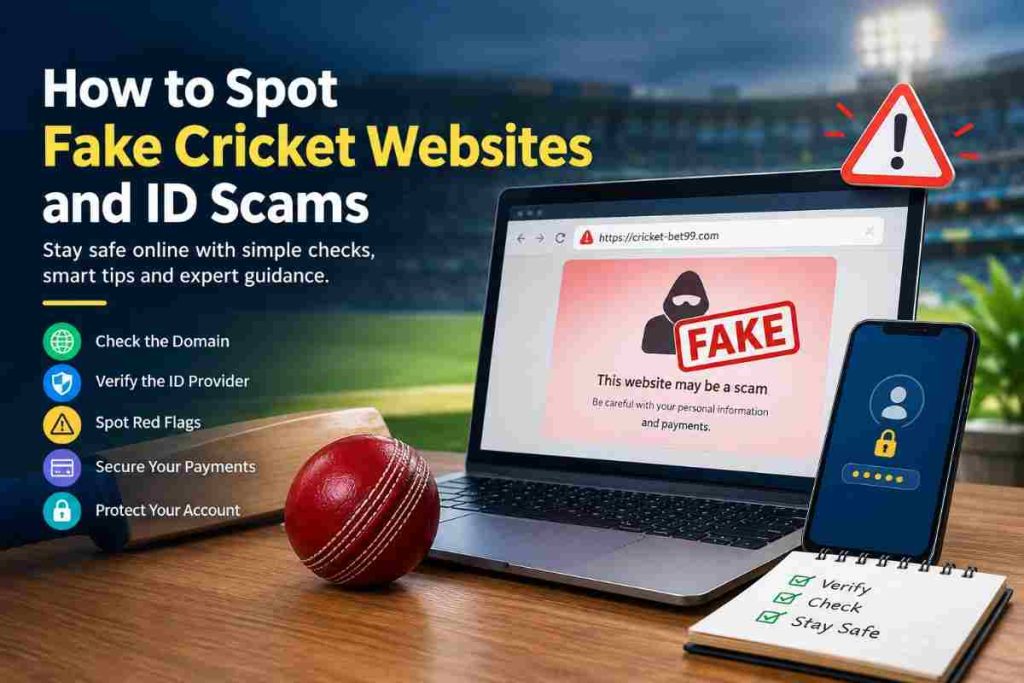
The excitement around cricket attracts millions of online users, but not every website offering cricket-related services operates honestly. Some websites imitate familiar brands, while questionable account providers use attractive offers and persuasive messages to gain people’s trust.
The challenge is that fraudulent websites do not always look suspicious. They may have professional designs, copied testimonials, customer support numbers, and payment pages that appear genuine.
That is why users need to look beyond appearances. Whether you are researching a cricket platform, checking a website’s authenticity, or evaluating an unfamiliar ID provider, a few careful checks can help you recognize potential risks before sharing sensitive information.
Why Do Fake Cricket Websites Look Genuine?
Fraudulent operators often copy elements from established websites to make their services appear credible. These may include brand names, logos, page layouts, promotional banners, and descriptions of customer support.
Some also create multiple domains with similar names. A user who clicks an advertisement or follows a message from an unknown contact may unknowingly visit an imitation website.
A familiar logo is not proof of ownership. Neither is a professional-looking homepage. The most important question is whether the website’s identity, domain, business information, and claims can be independently verified.
1. Investigate the Domain Before Trusting the Website
Start with the website address rather than its promotional content.
Compare the exact domain with the address published by a verified source. Look for unexpected spelling changes, additional words, misleading subdomains, or unusual redirects.
You can also review publicly available domain-registration information and the website’s history where those records are available. Recently created domains are not automatically fraudulent, but a newly registered address combined with aggressive promotions and missing business details deserves extra scrutiny.
Another useful step is to search the exact domain name alongside terms such as “complaint,” “fraud,” or “impersonation.” Evaluate the sources carefully instead of assuming that every online accusation is accurate.
Remember: HTTPS protects information transmitted between your browser and a website, but it does not verify the operator’s honesty or authorization.
2. Ask Who Actually Operates the ID Service
An online cricket ID provider may present itself as an individual agent, a customer support representative, or a partner of a familiar brand. Those descriptions should not be accepted without evidence.
Before sharing personal details, establish what organization is responsible for the service and whether the arrangement is lawful in your location.
Look for a consistent business identity, accessible terms and conditions, a privacy policy, and a clear process for handling complaints. If the service claims to hold a licence, check the claim against the relevant regulator’s official records.
Be especially cautious when an intermediary refuses to identify the business behind the service or says that verification is unnecessary because the provider is already popular.
A large social media following, a messaging-group membership count, or a collection of customer screenshots does not independently establish legitimacy.
3. Recognize the Pressure Tactics Used by Scammers
Fraudulent operators may try to prevent users from taking time to investigate their claims. Instead of providing verifiable information, they create urgency.
Common examples include:
- “Pay now or your account will be permanently blocked.”
- “Send an extra fee to unlock your balance.”
- “This offer expires in a few minutes.”
- “Guaranteed profit is available if you follow our instructions.”
- “Do not contact your bank; our agent will resolve everything.”
These statements are not proof of fraud on their own, but they are strong reasons to stop and verify the situation independently.
Legitimate business communication should explain the applicable terms without threatening users or demanding immediate decisions. Never send additional money simply because an unfamiliar representative claims that doing so will release a payment or restore an account.
4. Understand the Risks Behind Payment Requests
Payment disputes can become more complicated when users do not know who receives their money or what conditions apply to a transaction.
Before making any payment, check the recipient’s identity, the stated purpose of the transaction, and the written terms. Be wary of instructions that suddenly change the recipient account or introduce unexpected charges.
Never provide an OTP, UPI PIN, banking password, or card security code to someone claiming to help with a transaction. Genuine payment support should not require you to disclose these confidential credentials.
If a payment is marked pending, confirm its status through your bank or payment application. Avoid paying a second time until the original transaction has been checked.
If a platform or agent requests money to process a withdrawal, independently verify the requirement through reliable channels. Requests for repeated release fees can be a warning sign of an advance-fee scam.
5. Check Whether the Customer Support Process Makes Sense
Customer support can reveal important information about how a service operates.
A questionable provider may use different names across messages, move conversations between unrelated accounts, or refuse to provide written explanations for account restrictions. Another warning sign is a support representative who asks for remote access to your phone or computer.
When evaluating support, consider the following:
- Can you identify the organization the representative claims to represent?
- Are the contact details consistent with independently verified information?
- Does the representative explain policies clearly?
- Are complaints acknowledged and documented?
- Are you being asked to disclose confidential information or install unfamiliar software?
Do not assume that a WhatsApp number, Telegram account, or social media profile is an official support channel just because it uses a brand’s logo.
6. Protect Your Device From Suspicious Applications
Fake cricket websites may encourage users to install applications through direct APK downloads rather than an established app store. Some unverified applications can request excessive permissions or expose users to security risks.
Before installing an application, investigate its publisher and source. Review its requested permissions and consider whether those permissions are necessary for its stated purpose.
Avoid applications that instruct you to disable built-in security protections, install additional files from unknown sources, or grant remote access to an unfamiliar person.
If you have already installed a suspicious application, disconnect it from sensitive accounts where appropriate, revoke unnecessary permissions, uninstall it, and run your device’s security checks. If you entered banking credentials, contact your bank promptly and change compromised passwords using a trusted device.
7. Learn to Evaluate Online Reviews Properly
Reviews can help you discover potential problems, but they should be treated as evidence to investigate rather than a final verdict.
Look for detailed reports that explain what happened, when it happened, and how the company responded. Compare information across independent sources and pay attention to repeated patterns.
Be skeptical of reviews that contain identical wording, exaggerated promises, or no meaningful details about the service. A website displaying hundreds of positive testimonials may still be unreliable if those claims cannot be independently checked.
Likewise, one negative review does not automatically prove fraud. The goal is to assess the quality and consistency of the available evidence.
8. What to Do If You Have Already Been Scammed
If you suspect that a website or ID provider has deceived you, focus first on protecting your money, accounts, and personal information.
Take these steps as soon as possible:
- Stop sending money and end contact with anyone demanding further payments.
- Save the domain address, screenshots, messages, receipts, and transaction reference numbers.
- Contact your bank or payment provider immediately if a transaction is unauthorized or suspicious.
- Change passwords that may have been exposed, especially if you reused them on other accounts.
- If you shared sensitive identity information, follow the relevant provider’s guidance for protecting that information.
- Report the incident through the appropriate official channels.
In India, suspected cybercrime can be reported through the National Cyber Crime Reporting Portal at https://cybercrime.gov.in. For suspected financial cyber fraud, call 1930 promptly and follow the official reporting instructions.
Be alert to recovery scams as well. Someone may contact you claiming they can retrieve lost money in exchange for an advance fee. Verify any recovery service independently before engaging with it.
9. A Simple Risk Assessment Before Using a Website
Instead of judging a website by its design, assess its credibility using several independent checks.
| What to check | Potential warning sign |
| Domain identity | Similar-looking or unexplained alternative address |
| Business information | Operator cannot be identified or verified |
| Legal information | Required authorization cannot be confirmed |
| Promotions | Guaranteed returns or misleading bonus claims |
| Payments | Unexpected charges or unexplained recipient changes |
| Customer support | Threats, inconsistent identities, or requests for OTPs |
| Applications | Unknown downloads or excessive device permissions |
| Public feedback | Repeated, credible reports of unresolved problems |
One warning sign may require further investigation; several together should make you particularly cautious. Do not proceed with a transaction until important concerns have been resolved.
Final Thoughts
Choosing whether to trust an online cricket website requires more than checking its branding, promotional offers, or popularity. Domain verification, transparent business information, sensible payment procedures, secure account practices, and independently reviewed evidence provide a much stronger basis for evaluating a service.
These precautions also apply when investigating websites associated with familiar names such as CrickBet99. A similar name does not establish that a website is affiliated with a particular brand, so always verify the exact domain and operator.
The safest approach is to slow down whenever a service creates urgency, requests confidential information, or makes promises that seem unrealistic. A few minutes spent checking the facts can help prevent much bigger problems later.