
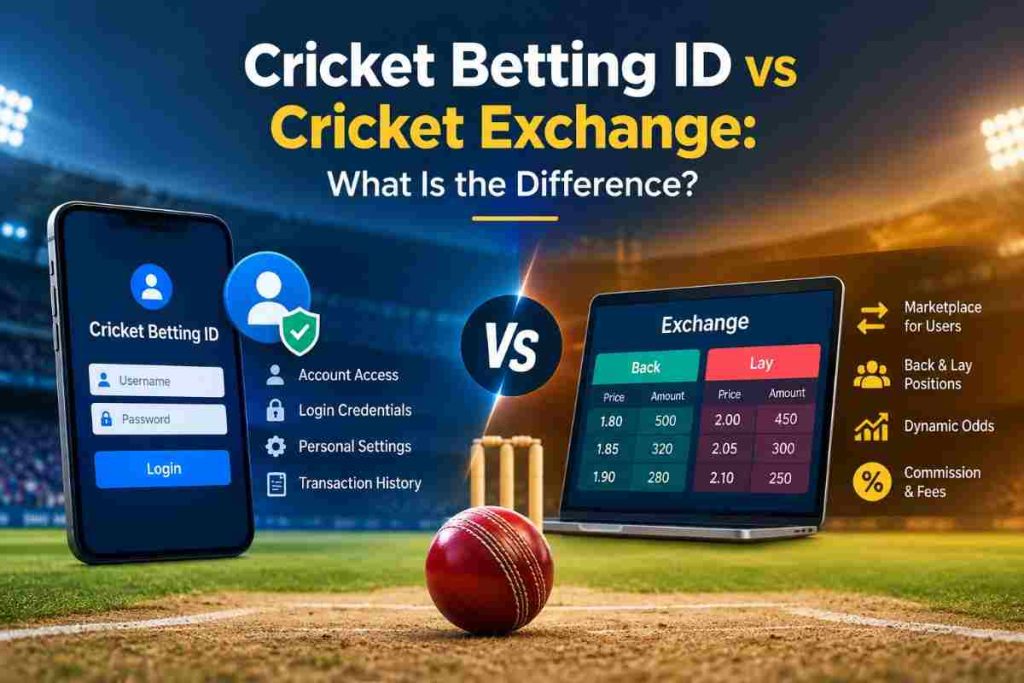
Cricket fans often come across terms such as cricket betting ID, cricket exchange ID, and online cricket account when researching digital cricket platforms. Although these terms are sometimes used interchangeably, they can refer to different things depending on the platform.
Understanding the difference helps readers learn how account access works, how cricket exchanges operate, and what features may be available. In this guide, we explain the key terms, common exchange features, and important account-safety considerations in simple language.
What Is a Cricket Betting ID?
A cricket betting ID generally refers to the account credentials or account identifier used to access an online platform that offers cricket-related markets. Depending on the service, an account may include login details, a balance, transaction records, account settings, and activity history.
The term itself does not tell you how the platform operates. Some services use bookmaker-style odds, while others provide access to a betting exchange. The available features depend on the specific platform and its terms.
Before using any service, check its eligibility requirements, applicable local laws, account conditions, and the way it handles personal information and transactions.
What Is a Cricket Exchange?
A cricket exchange is a marketplace where users can take opposing positions on an event. Rather than the operator acting as the direct counterparty to every transaction, the exchange matches users who are willing to accept opposite sides of a market.
For example, one user may want to back a team to win, while another may be willing to lay that team. A transaction can be matched when the available price and amount meet the exchange’s requirements.
Exchange prices may change as the match progresses, and an offer may remain unmatched if there is no suitable counterparty. Therefore, seeing a price on the screen does not necessarily mean a transaction has been completed.
Cricket Betting ID vs Cricket Exchange: Key Differences
The main difference is that a cricket betting ID is an account-access term, whereas a cricket exchange describes a type of marketplace. A cricket exchange ID usually means the account credentials used to access an exchange.
| Feature | Cricket Betting ID | Cricket Exchange |
| Meaning | An account or login identifier | A marketplace for matching opposing positions |
| Main purpose | Access an online platform | Connect users taking opposite sides of a market |
| Odds | Depend on the platform’s model | Influenced by available offers and market activity |
| Back and lay | Depends on the platform | May support both back and lay positions |
| Account access | Uses the service’s supported login method | Requires eligible account access to the exchange |
| Fees or commission | Depends on the service’s terms | May charge commission under its rules |
These terms are not always mutually exclusive. A person can have a cricket betting ID that provides access to an exchange, so the exact meaning should be confirmed with the service being discussed.
What Do Back and Lay Mean on a Cricket Exchange?
Two common terms associated with exchanges are back and lay.
Back: Taking a position that a particular outcome will happen. For example, a user may select a team in a match-winner market.
Lay: Taking the opposite side of that outcome. Depending on the market, this can mean accepting a position against the selected team winning.
Laying can involve a liability greater than the amount a user expects to receive if the position succeeds. The amount at risk should be understood before any transaction is considered. Neither backing nor laying guarantees a profit, and match results can be unpredictable.
For a related explanation, see our Back and Lay Betting guide.
How Do Cricket Exchange Odds Work?
Exchange odds reflect the prices available from users on opposite sides of a market. These prices can change when new offers appear, existing offers are matched, or match events affect participants’ expectations.
Consider decimal odds of 2.00 as a mathematical example. A successful back position at that price would produce a gross return of two times the stake, including the original stake, before any applicable commission or other deductions. If the outcome does not occur, the stake may be lost.
This is an illustration of how decimal odds work, not a prediction of a match result. Actual prices, transaction rules, and charges vary by service and market.
Read our Cricket Betting Odds guide for more information about odds and probability.
What Should You Check Before Using an Online Cricket Platform?
Before creating or accessing an account, take time to check the following:
- Legal eligibility: Confirm whether the service is permitted where you live and whether you meet its age requirements. Laws differ by jurisdiction and may change.
- Terms and conditions: Read the rules covering account access, transactions, fees, restrictions, and dispute handling.
- Account security: Use a unique password and never share passwords, PINs, or one-time verification codes.
- Privacy: Review how the service collects, stores, and uses personal information.
- Transaction records: Understand how deposits, withdrawals, refunds, and account balances are recorded, where those features are offered.
- Risk limits: Never use money needed for essentials, borrow to participate, or chase losses.
Do not assume a service is licensed, secure, or lawful simply because it provides a login ID or uses the word “exchange.” Verify relevant information independently.
Frequently Asked Questions
Is a cricket betting ID the same as a cricket exchange ID?
Not always. A cricket betting ID is a general term for account access, while a cricket exchange ID usually refers to credentials for an exchange. Some platforms use the terms interchangeably, so check what the particular service provides.
Does every cricket betting platform offer an exchange?
No. Some platforms use bookmaker-style markets, while others provide exchange functionality. Features vary by provider and account type.
What is the difference between back and lay?
Backing means taking a position that an outcome will happen. Laying means taking the opposite side. Lay positions can involve substantial liability, so users should understand the applicable rules and maximum potential loss.
Do exchange odds remain the same throughout a cricket match?
No. Prices may change as match conditions and available offers change. A displayed offer may also remain unmatched if a suitable counterparty is unavailable.
Is having a cricket exchange ID proof that a platform is safe or legal?
No. An account ID only provides access. It does not establish that a service is licensed, secure, or lawful in your location. Check official sources and the platform’s terms before using any service.
Final Thoughts
The difference between a cricket betting ID and a cricket exchange is straightforward: the ID relates to account access, while the exchange describes the marketplace itself. An exchange account may provide access to features such as back and lay markets, but the exact functionality depends on the platform.
Understanding the terminology, checking the applicable rules, protecting account credentials, and recognising the financial risks are all important when evaluating online cricket services.