
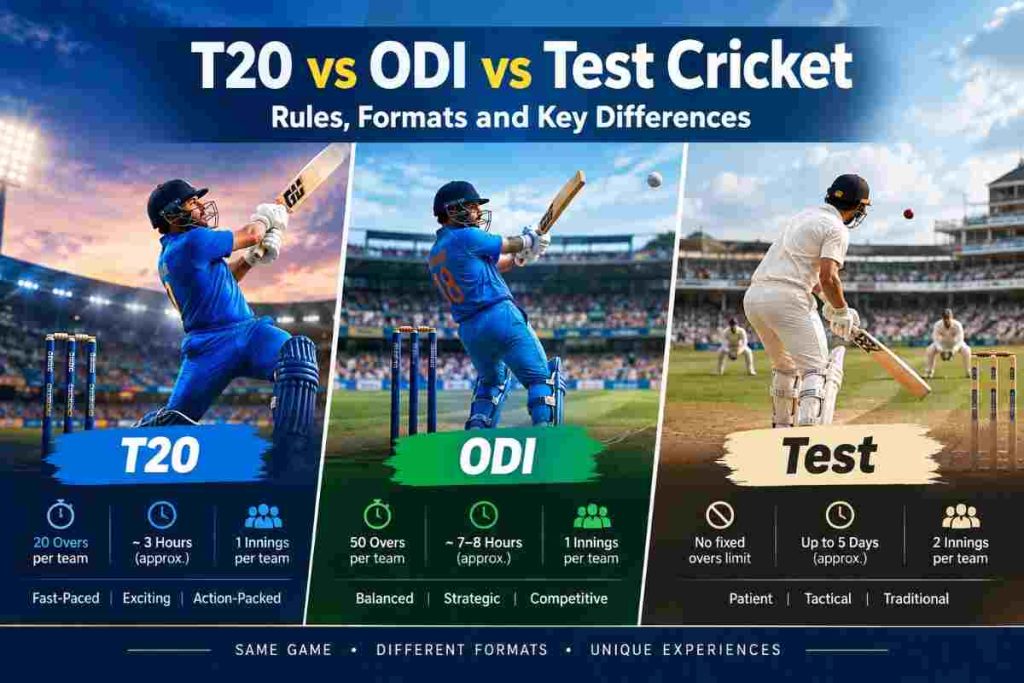
Cricket is played in different formats, each offering a unique experience for players and fans. The three main international formats are Twenty20 (T20), One Day International (ODI), and Test cricket. Although all three formats follow the basic rules of cricket, they differ in match duration, number of overs, team strategies, and playing conditions.
Understanding the differences between T20, ODI, and Test cricket helps beginners follow matches more easily and appreciate the strategies used by different teams. This guide explains the key rules, format differences, and important terms associated with each type of cricket.
What Is T20 Cricket?
T20 cricket is the shortest of the three main formats. Each team usually plays a maximum of 20 overs, making matches faster and more action-packed.
T20 cricket became popular because of its shorter duration, aggressive batting, and exciting finishes. The format is widely associated with domestic leagues, including the Indian Premier League (IPL), as well as international competitions.
Key Rules of T20 Cricket
- Each team generally has a maximum of 20 overs to bat.
- A bowler can normally deliver a maximum of four overs in a full innings.
- Fielding restrictions apply during designated powerplay overs.
- Teams often focus on scoring quickly while managing wickets.
- A match may be shortened or adjusted under the relevant competition’s playing conditions.
T20 matches typically take around three hours, although interruptions and other circumstances can affect the duration.
What Is One Day International (ODI) Cricket?
One Day International cricket is a limited-overs format in which each team normally receives a maximum of 50 overs. It offers a balance between aggressive batting and longer-term match planning.
ODI cricket requires teams to manage their scoring rate, preserve wickets, and adapt their strategy throughout the innings. Unlike T20 cricket, teams have more overs to build partnerships and recover after losing wickets.
Key Rules of ODI Cricket
- Each team normally has a maximum of 50 overs to bat.
- A bowler can generally deliver a maximum of 10 overs in a full innings.
- Powerplay and fielding restrictions apply according to the playing conditions.
- Teams must balance scoring speed with wicket preservation.
- Rain interruptions may lead to revised targets or reduced overs under the applicable rules.
An ODI match usually takes around seven to eight hours, depending on interruptions and the pace of play.
What Is Test Cricket?
Test cricket is the longest traditional format of the game. International Test matches are scheduled over a maximum of five days, allowing teams to develop strategies across multiple innings.
Unlike limited-overs formats, Test cricket does not impose a fixed maximum number of overs for a team’s innings. Instead, innings end when the relevant dismissal conditions, declarations, or other playing rules apply.
Key Rules of Test Cricket
- A match is scheduled for up to five days.
- Each team normally has two innings, subject to the match situation and applicable rules.
- There is no standard fixed maximum number of overs per innings.
- Teams can declare an innings closed when the rules permit.
- A match may finish in a win, draw, or tie.
Test cricket places considerable emphasis on technique, patience, bowling endurance, pitch conditions, and tactical decision-making over an extended period.
T20 vs ODI vs Test Cricket: Main Differences
The following table summarises the standard format differences.
| Feature | T20 Cricket | ODI Cricket | Test Cricket |
| Overs per team | Maximum 20 | Maximum 50 | No fixed maximum |
| Scheduled duration | Around 3 hours | Around 7–8 hours | Up to 5 days |
| Innings per team | Normally 1 | Normally 1 | Normally 2 |
| Batting approach | Aggressive and rapid | Balanced and adaptable | Patient and strategic |
| Bowling workload | Maximum 4 overs per bowler in a full innings | Maximum 10 overs per bowler in a full innings | No equivalent standard overs-per-innings limit |
| Possible result | Win or tie; competition rules may provide a Super Over | Win or tie; competition rules may provide a Super Over | Win, draw, or tie |
| Common competitions | IPL and T20 World Cup | ODI World Cup and bilateral series | World Test Championship and Test series |
Actual match duration and some playing conditions can vary by competition, interruptions, and official regulations.
How Do Strategies Differ Across the Three Formats?
T20: Fast Scoring and Quick Decisions
T20 teams often aim to score rapidly from the beginning. Batters may target boundaries, while bowlers use variations and field placements to limit scoring opportunities. Because each team has fewer overs, individual performances can have a significant effect on the final result.
ODI: Balancing Risk and Consistency
ODI cricket provides more time to build an innings. Teams may begin cautiously, accelerate during the middle overs, and increase scoring toward the end. Bowlers and captains must adapt their plans as the match develops.
Test: Patience and Long-Term Planning
Test cricket rewards consistency and discipline. Batters may spend hours building an innings, while bowlers attempt to create pressure over multiple spells. Captains must consider pitch deterioration, weather, remaining time, and the possibility of a draw.
Which Cricket Format Is Best for Beginners?
The best format depends on what a viewer enjoys.
- T20 cricket: Suitable for viewers who prefer shorter matches and fast-paced action.
- ODI cricket: A good choice for people who enjoy a combination of attacking play and tactical development.
- Test cricket: Ideal for viewers interested in technical skills, bowling strategy, and the longer story of a match.
Following all three formats can provide a broader understanding of cricket and the different skills required at the highest level.
How Cricket Formats Affect Match Analysis
The format of a match influences how teams approach batting, bowling, and field placement. For example, a run rate of eight runs per over may be a common target in some T20 situations but would represent a very different scoring pace in a Test match.
When analysing a match, it is useful to consider the number of overs remaining, wickets lost, pitch conditions, team composition, and the format’s specific playing rules.
These factors help explain why a strategy that works in T20 cricket may not be suitable for an ODI or Test match. However, no statistic or analysis method can guarantee a particular match outcome.
Readers researching cricket exchange terminology or related information through websites such as CrickBet99 should understand these format differences before interpreting match statistics. Always verify website authenticity and check applicable laws before using any betting-related service.
Conclusion
T20, ODI, and Test cricket share the same basic foundations but offer different challenges. T20 focuses on rapid scoring, ODI cricket balances aggression with consistency, and Test cricket rewards patience and long-term strategy.
Learning the rules and characteristics of each format makes cricket easier to understand, whether you are following the IPL, an international ODI series, or a five-day Test match. By understanding overs, innings, match duration, and team strategies, beginners can develop a stronger appreciation of the game.