
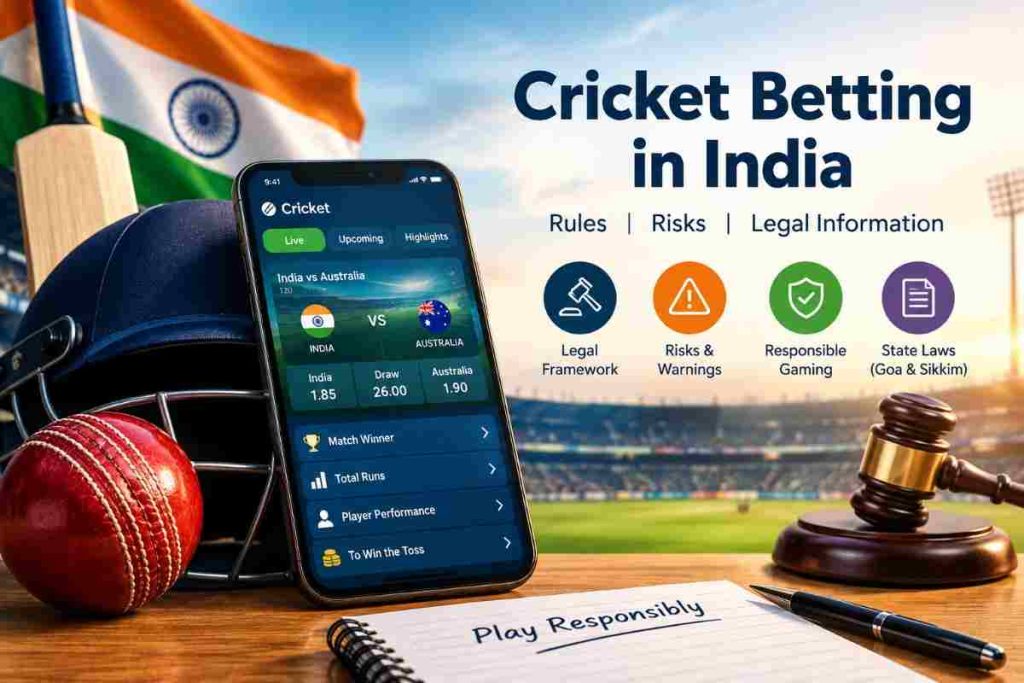
Cricket is one of the most popular sports in India, and searches related to cricket betting, match odds, cricket exchanges and online gaming are common among sports fans. However, anyone researching cricket betting in India should understand an important point: the legal position depends on the type of activity, the applicable law and whether the activity involves real-money stakes.
India’s gaming laws have also changed significantly in recent years. State-level gambling laws were historically important, but the country now has a central framework specifically addressing online money games. This makes it important to distinguish between traditional casinos, state-regulated gaming activities, online games and online betting services.
Is Cricket Betting Legal in India?
There is no longer a simple answer based only on whether a particular state historically permitted some forms of gambling.
India’s traditional gambling framework includes state laws as well as older central legislation. States have historically adopted different approaches to gambling and gaming. For example, Goa has a specific legal framework under the Goa, Daman and Diu Public Gambling Act, 1976, which provides the basis for regulation of certain licensed casino activities. The Goa Government continues to list this legislation among the Acts administered by its Home Department and publishes information concerning onshore and offshore casinos.
This does not, however, mean that every form of online betting or cricket betting is automatically legal in Goa.
The distinction between a licensed casino activity and an online money game is important.
What Changed With the Online Gaming Act?
A major change came with the Promotion and Regulation of Online Gaming Act, 2025.
The Act created a national framework for online gaming and specifically addresses online money games. It prohibits the offering, operation and facilitation of online money games and also covers their advertising and promotion. The legislation applies to online money games whether they involve chance, skill, or a combination of the two.
The government subsequently notified the Promotion and Regulation of Online Gaming Rules, 2026. These Rules came into force on 1 May 2026 and provide the procedures for implementing the 2025 Act.
According to the government’s explanation of the framework, online money games are prohibited even where the underlying game involves skill. The framework also restricts advertising, promotion and facilitation of prohibited online money games.
This is particularly relevant to online cricket betting because a service involving money or stakes and an expectation of monetary winnings can fall within the online-money-game framework.
What About Goa?
Goa is frequently mentioned in discussions about gambling in India because it has a long-standing state framework for licensed casinos.
The Goa, Daman and Diu Public Gambling Act, 1976 provides the legislative framework for certain gambling and casino activities in Goa. The state government continues to publish information about licensed onshore and offshore casinos.
However, it would be inaccurate to take this information and conclude that online cricket betting is legal in Goa simply because casinos are permitted under a state licensing framework.
A physical casino licensed under Goa’s state law and an online platform accepting money for cricket-related outcomes are different legal categories.
Therefore, anyone publishing information about cricket betting should avoid statements such as:
“Cricket betting is completely legal in Goa.”
A more accurate statement is:
“Goa has a state-regulated framework for certain licensed casino activities, but this should not be interpreted as general permission for online money betting or online cricket betting.”
This distinction is especially important after the central online gaming framework came into force.
What About Sikkim?
Sikkim provides another useful example of why India’s gaming laws should be understood carefully.
The Government of Sikkim states that the state introduced online games and sports gaming under the Sikkim Online Gaming (Regulation) Act, 2008, as amended in 2009. The state’s Directorate of State Lotteries says that online games and sports gaming are under its administrative control and that the state has issued licences for such activities.
The legislation historically provided a licensing mechanism for online gaming and sports gaming. The law also contained restrictions concerning where licensed online games could be operated and made available.
However, these historical state provisions should not be presented as proof that a person can currently use any online betting website from anywhere in India.
The national legal framework introduced in 2025 and implemented through the 2026 Rules has changed the regulatory environment for online money games.
Why State Laws Can Be Confusing
The confusion comes partly from India’s historical division of gambling regulation.
Different states have adopted different approaches to gambling, lotteries, casinos and games involving skill or chance. As a result, older articles often describe particular states as having more permissive gambling laws.
But online gaming creates an additional layer because an internet-based service can operate across state boundaries.
The 2025 central legislation was specifically designed to create a national framework for online gaming and addresses online money games offered through computers, mobile devices and the internet.
Therefore, an article written several years ago saying that a particular state permitted a certain form of gaming may not accurately describe the legal position for an online money game in 2026.
What Counts as an Online Money Game?
The central framework focuses on whether an online game involves money or another stake and an expectation of monetary or other enrichment.
The government’s 2026 explanation says that the determination of whether a game is an online money game can consider factors such as payment of stakes, the expectation of monetary winnings, the revenue model and monetisation of in-game assets outside the game.
This means the name used by a website is not necessarily what determines its legal classification.
For example, calling a service a “cricket game,” “cricket exchange” or “sports platform” does not by itself establish that the service is outside the online-money-game framework.
The actual structure of the activity matters.
What Are Cricket Betting Odds?
Cricket betting odds are numbers or prices associated with possible outcomes of a sporting event.
Depending on the service, markets may relate to:
- Match winner
- Innings result
- Total runs
- Player performance
- Over-by-over outcomes
- Other cricket-related events
Odds can change as circumstances change. Factors such as the toss, playing XI, injuries, weather, pitch conditions and the actual progress of a match can affect market prices.
Importantly, odds do not guarantee an outcome.
A particular team having shorter odds does not mean that the team must win. Cricket remains an uncertain sporting event.
Financial Risks of Cricket Betting
Apart from legal considerations, money-based betting carries financial risk.
A person can lose the amount they stake, and repeated losses can become larger if someone continues to increase their stakes in an attempt to recover previous losses.
Common warning signs include:
- Spending more than planned
- Chasing losses
- Borrowing money to continue betting
- Using money needed for essential expenses
- Hiding betting activity from family or friends
- Treating betting as a guaranteed source of income
Betting should not be described as an investment or guaranteed earning method.
Online Payments and Account Security
Anyone dealing with an online money-based service should understand its payment and account policies.
Important information can include:
- Deposit methods
- Withdrawal procedures
- Identity verification
- Minimum and maximum transaction limits
- Processing conditions
- Account restrictions
- Fees
- Terms and conditions
Users should also protect their passwords, banking information and one-time passwords. No legitimate service should require a user to disclose confidential authentication credentials to another person.
How to Check Whether a Website Is Legitimate
A website being accessible in India does not automatically mean that it is legally authorised.
Before relying on claims made by an online platform, users should check:
- The legal name of the operator.
- The jurisdiction in which the operator claims to be licensed.
- Whether the claimed licence can be independently verified.
- The website’s terms and conditions.
- Its privacy policy.
- Deposit and withdrawal rules.
- Responsible-gaming information.
- Applicable geographic restrictions.
- Whether its activities comply with India’s current online-gaming framework.
Claims such as “government approved,” “fully legal in India,” “guaranteed payouts” or “100% safe” should not be accepted without independent evidence.
Responsible Gaming and Financial Awareness
Legal questions are only one part of the issue.
Money-based gaming can create financial problems when users spend more than they can afford to lose. Setting a personal limit and avoiding the use of essential household money are important safeguards.
People should also avoid chasing losses. Losing money does not create an obligation to continue playing in an attempt to recover it.
If gambling or betting begins to interfere with finances, work, studies, relationships or daily activities, stopping and seeking appropriate support is important.
Conclusion
Cricket betting in India needs to be understood in the context of both historical state gambling laws and the country’s newer national framework for online gaming.
Goa is an important example because the state has a specific legal framework for licensed casino activities, including onshore and offshore casinos. Sikkim has also historically maintained a licensing framework for certain online games and sports gaming.
However, these examples should not be used to claim that online cricket betting is generally legal in those states today.
The Promotion and Regulation of Online Gaming Act, 2025, together with the Online Gaming Rules, 2026, now provides a central framework that prohibits online money games and related advertising, promotion and facilitation. The Rules came into force on 1 May 2026.
For anyone researching cricket betting, the safest approach is to check the current law, the nature of the activity, the operator’s legal status and the rules applicable to the user’s location rather than relying on old claims or general statements found online.
This article is for general informational purposes and should not be treated as legal advice. Laws and regulations can change, so readers should consult current official government sources or a qualified legal professional for advice about a specific situation.


One Response