
Cricket has become increasingly connected with digital sports platforms, giving fans new ways to follow matches and understand live market activity. One of the most important concepts in this space is the cricket exchange. Unlike traditional fixed-odds formats, an exchange-style market can provide different ways to take a position on a potential match outcome.
For people researching online cricket platforms, terms such as CrickBet99, Cric99, and CricBet99 Green may also appear in search results. However, understanding how an exchange works is more important than simply knowing the names of individual platforms.
This guide explains the basic concepts of cricket exchanges, including back and lay markets, changing prices, live match conditions, and responsible participation.
What Is a Cricket Exchange?
A cricket exchange is a sports-market system where users can interact with available selections rather than simply accepting a single fixed price from a traditional bookmaker.
The exchange generally displays available prices for different outcomes. Users can choose a position based on whether they expect a particular outcome to happen or not happen.
The market can change continuously as new information becomes available. In cricket, this can happen particularly quickly because every delivery can potentially affect the match.
For example, a wicket may significantly change the expected outcome of a match. Similarly, a quick scoring partnership, a required run rate, or a change in bowling conditions can influence market prices.
Understanding the Back Market
The first important term is Back.
A back position generally means taking a position in favour of a particular outcome.
For example, imagine a cricket match between Team A and Team B. If a user believes Team A will win, they could look for the available back price for Team A.
The potential return depends on the amount involved and the available price.
However, a back position does not guarantee a successful outcome. Cricket remains unpredictable, and even a strong team can lose because of changing match conditions.
Understanding the Lay Market
The second major concept is Lay.
A lay position generally means taking a position against a particular outcome.
Using the same example, if a user believes Team A will not win, they may consider the available lay market against Team A.
This creates one of the key differences between exchange-style markets and conventional betting formats. Instead of only selecting an outcome you believe will happen, an exchange can allow you to take a position against an outcome as well.
Understanding this distinction is essential before interacting with exchange markets.
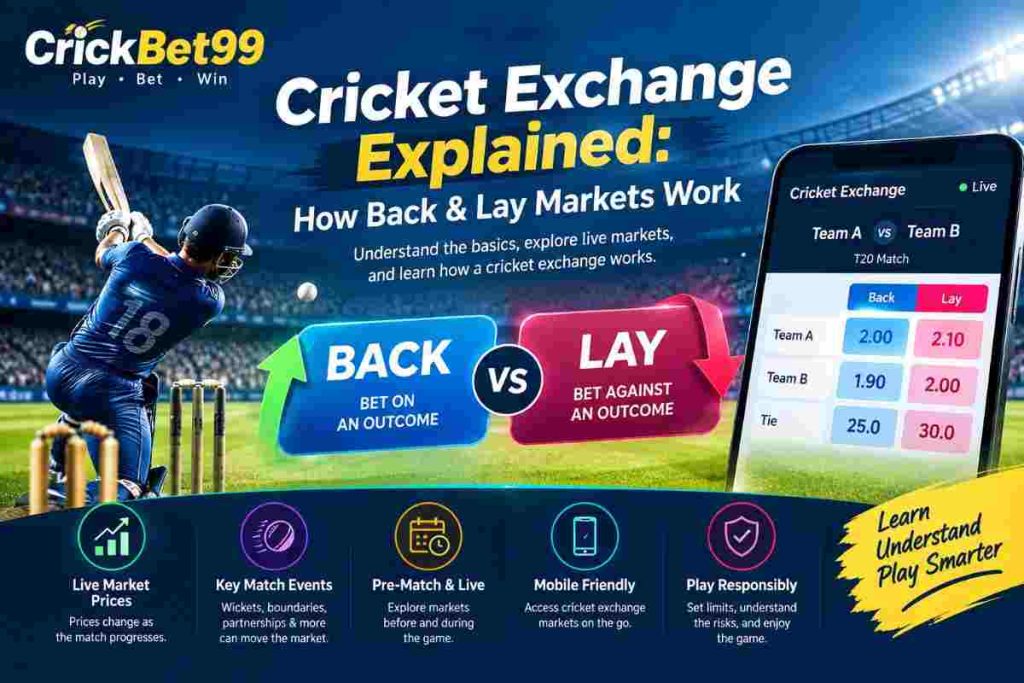
Back vs Lay: A Simple Example
Consider a hypothetical cricket match:
Team A vs Team B
Suppose the market shows:
- Back Team A: 2.00
- Lay Team A: 2.10
A back position is based on Team A winning, while a lay position is based on Team A not winning.
The exact financial calculation depends on the amount, market rules, and platform structure. Users should therefore understand the relevant terminology and potential liability before placing any position.
The numbers in this example are purely illustrative and do not represent current market prices.
Why Cricket Exchange Prices Change
One of the defining characteristics of a cricket exchange is that prices can move.
Several factors can influence a market, including:
Match Score
The current score can dramatically affect expectations, particularly during limited-overs cricket.
Wickets
A wicket can immediately change the balance of a match and therefore influence available prices.
Required Run Rate
In a T20 or ODI chase, the number of runs required compared with the remaining overs can influence how the market develops.
Partnerships
A strong partnership can improve one team’s position, while a collapse can quickly shift expectations.
Player Performance
The availability and performance of important batsmen and bowlers can influence match expectations.
Weather and Playing Conditions
Rain interruptions, pitch conditions, and other external factors can also affect a cricket match and its associated markets.
Because these factors change throughout a match, exchange prices can move quickly.
Pre-Match vs Live Cricket Exchange
Cricket exchange markets can generally be considered in two broad situations: before the match and during the match.
Pre-Match Markets
Before a match begins, users may review available markets based on team form, player availability, previous performances, and other publicly available information.
However, pre-match expectations do not guarantee what will happen once the game begins.
Live Markets
Live or in-play markets operate while the match is taking place.
This can create a much more dynamic environment because every major event can affect the available market.
A wicket, boundary, dropped catch, strategic bowling change, or sudden change in required run rate can all influence market conditions.
CrickBet99 and Cricket Exchange Searches
People researching cricket exchange platforms may come across different brands and search variations, including CrickBet99, Cric99, and CricBet99 Green.
These terms can appear in searches related to cricket platforms, account access, or online cricket markets. Users should not assume that every website using a similar keyword is connected to the same service.
When researching any online platform, it is important to verify the website address and review the relevant terms before providing account or personal information.
Why Understanding Exchange Terminology Matters
A common mistake among beginners is entering a market without understanding what the terms mean.
Before using a cricket exchange, users should understand:
- What Back means
- What Lay means
- How prices work
- What potential liability means
- How live markets can change
- How different market types operate
- What the platform’s terms and conditions say
Learning these concepts first can make it easier to understand the information displayed on an exchange.
Cricket Exchange and IPL Markets
The popularity of T20 competitions has contributed to interest in live cricket markets. The IPL, in particular, attracts a large global audience and produces matches with frequent changes in momentum.
During an IPL match, a six, wicket, partnership, or bowling change can alter the perceived strength of either team.
This makes IPL-related exchange markets particularly dynamic. However, users should remember that fast-changing markets also involve financial risk.
Common Cricket Exchange Terms
Here are several terms beginners may encounter:
Back: A position in favour of an outcome.
Lay: A position against an outcome.
Odds/Price: The market value associated with an available selection.
Stake: The amount associated with a position.
Liability: The amount that may be at risk on a lay position depending on the market and price.
In-Play: A market that operates while the sporting event is taking place.
Understanding these terms provides a foundation for navigating exchange-style markets.
Responsible Participation
A cricket exchange should be approached as a form of entertainment rather than a guaranteed way to make money.
Sports outcomes cannot be predicted with certainty, and even detailed analysis does not remove financial risk.
Users should set personal limits, avoid chasing losses, never use essential funds, and take breaks when necessary. It is also important to check whether sports betting or exchange participation is legally permitted in your location and to follow applicable age requirements.
Final Thoughts
A cricket exchange provides a different way to understand and interact with sports markets. The concepts of Back and Lay are at the center of exchange-style systems, while prices can change as match conditions develop.
For cricket fans researching digital platforms, terms such as CrickBet99, Cric99, and CricBet99 Green may appear during online searches. Regardless of the platform or keyword being researched, users should verify websites carefully and understand the relevant market rules before participating.
The most important first step is education. Understanding how back and lay positions work, how prices change, and what financial risks are involved can help users make more informed decisions when exploring the world of cricket exchanges.