
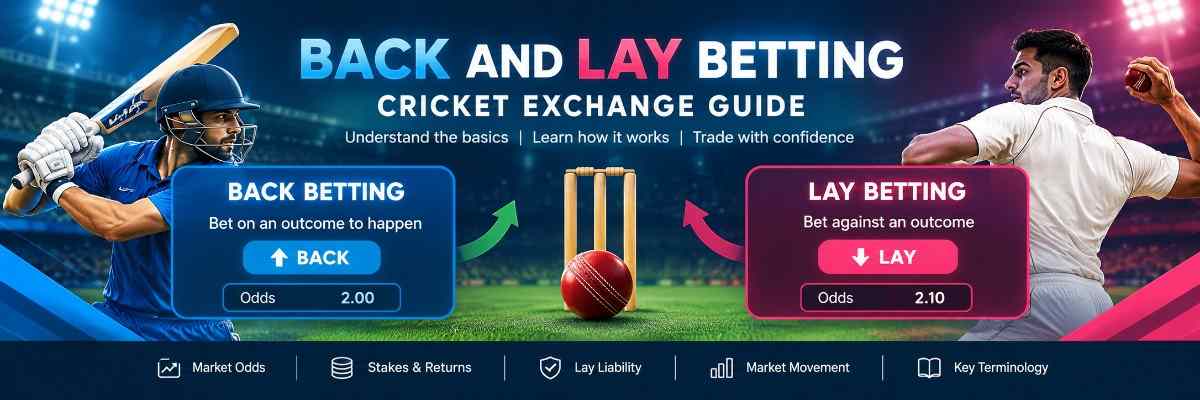
Back and Lay Betting: A Complete Guide to Cricket Exchange Markets
Back and lay betting are two fundamental concepts used in exchange-style sports betting. Unlike traditional betting, where a player generally chooses an outcome and places a bet against a bookmaker’s odds, an exchange allows users to take either side of a market. For cricket fans, understanding back and lay betting can make it easier to understand how cricket exchange markets work, how odds move during a match, and why different prices are available for the same outcome. This guide explains the basic difference between back and lay betting, how odds work, and the terminology commonly used in cricket exchange markets.
What Is Back Betting?
Back betting means placing a bet on an outcome that you believe will happen.
For example, imagine a cricket match between Team A and Team B. If you select Team A to win and place a back bet, your selection is Team A.
If Team A wins the match, a successful back bet can generate a return according to the odds and stake selected.
The basic concept is:
Back = betting that an outcome will happen.
Back betting is similar to the traditional way most people understand sports betting. The difference is that an exchange-style market displays available prices and allows users to interact with those market prices.
What Is Lay Betting?
Lay betting works in the opposite direction.
When you place a lay bet, you are taking the position that a particular outcome will not happen.
For example, suppose Team A is playing Team B. Instead of backing Team A to win, a user could lay Team A.
If Team A does not win according to the market’s settlement rules, the lay position can be successful.
The basic concept is:
Lay = betting that an outcome will not happen.
Lay betting is one of the main features that distinguishes an exchange-style market from conventional bookmaker betting.
Back vs Lay Betting
The easiest way to understand the difference is to compare the two positions:
Feature | Back Betting | Lay Betting |
Basic idea | Outcome will happen | Outcome will not happen |
Example | Team A will win | Team A will not win |
Market position | Supporting an outcome | Opposing an outcome |
Common use | Selecting a potential winner | Taking the opposite side of a selection |
Exchange terminology | Back | Lay |
The appropriate choice depends on the position a user wants to take and the available market price.
How Back and Lay Odds Work
Odds represent the price associated with a particular market position.
Suppose Team A has back odds of 2.00. A stake of ₹100 at those odds would produce ₹200 in total return if the bet is successful, including the original stake, before any applicable fees or deductions.
Lay betting introduces another important concept called liability.
For example, if a user lays a selection at odds of 2.00 with a ₹100 lay stake, the potential liability is:
₹100 × (2.00 − 1) = ₹100
The actual calculation can vary depending on the exchange’s market structure, fees, and rules, so users should always check the platform’s terms before placing a position.
What Is Lay Liability?
Lay liability is the amount that a person may lose if the outcome they have laid actually occurs.
This is particularly important for anyone learning how exchange betting works.
For a simple example:
- Lay odds: 3.00
- Lay stake: ₹100
- Potential liability: ₹200
The formula is:
Liability = Lay Stake × (Odds − 1)
Therefore:
₹100 × (3.00 − 1) = ₹200
Understanding liability is essential because the amount at risk in a lay position is not always the same as the amount entered as the lay stake.
Back and Lay Betting in Cricket
Cricket is particularly suited to exchange-style markets because matches contain many changing situations.
Markets can change as:
- A wicket falls
- A batter reaches a milestone
- The run rate changes
- A team loses several wickets
- A chase gets closer to its target
- Rain interrupts play
- A key player enters or leaves the game
- The required run rate changes
These events can affect the market’s perception of an outcome and therefore influence available odds.
For example, a team may have one set of odds before the first ball and significantly different odds later in the innings.
What Are Cricket Exchange Markets?
A cricket exchange market allows different selections and prices to be displayed for a particular event.
Depending on the platform and market, users may find markets related to:
- Match winner
- Innings totals
- Team runs
- Player performances
- Wickets
- Over or session markets
- Other cricket-specific outcomes
The availability of markets can vary by competition, match, location, and platform.
Users should always check the individual market rules before participating.
Back and Lay During Live Matches
Live or in-play cricket markets can change rapidly because the match is continuously developing.
Before placing a position, users should understand that displayed odds may change before a transaction is confirmed.
For example, if a team loses an important wicket during a chase, the available market prices may move almost immediately.
This means users should pay attention to:
- Current score
- Wickets remaining
- Required run rate
- Overs remaining
- Match situation
- Player availability
- Weather interruptions
- Market suspension rules
Live markets can involve greater uncertainty because circumstances can change quickly.
Understanding the Back and Lay Price
Exchange markets commonly display two different prices:
Back price: The price available for someone wanting to back an outcome.
Lay price: The price available for someone wanting to lay that outcome.
The difference between these prices is commonly referred to as the spread.
For example:
Position | Example Odds |
Back | 2.00 |
Lay | 2.10 |
The actual prices available in a market can change continuously depending on market activity and other factors.
What Is a Market?
A market is a specific betting event or outcome within a sporting event.
For example:
Match Winner
- Team A
- Team B
Another market could focus on a particular innings or player-related outcome.
Each market can have its own rules concerning settlement, void conditions, delays, abandoned matches, and other circumstances.
Always read the market rules before participating.
What Is Market Movement?
Market movement refers to changes in available odds over time.
In cricket, market movement can occur because of developments during the match or changes in how participants assess the likely outcome.
For example, before a match begins, Team A might have odds of 1.80. After a strong start, those odds might change.
There is no guarantee that a particular market movement will continue in the same direction.
Back and Lay Betting Example
Consider a hypothetical cricket match between Team A and Team B.
Team A has:
- Back odds: 2.00
- Lay odds: 2.10
A user interested in backing Team A could consider the available back price.
Another user who wants to take a lay position against Team A could consider the available lay price.
The two positions have different risk and return characteristics.
This simple example demonstrates why understanding the distinction between stake, odds, return, and liability is important before using an exchange market.
Important Terms to Know
Stake
The amount of money associated with a betting position.
Odds
The price assigned to a particular outcome.
Back
A position taken on an outcome happening.
Lay
A position taken against an outcome happening.
Liability
The potential amount at risk on a lay position.
Market
A specific event or outcome available for trading or betting.
Market Movement
Changes in available prices as circumstances and market participation change.
In-Play
A market that is available while the sporting event is taking place, subject to platform rules.
Back and Lay Betting on CrickBet99
CrickBet99 provides cricket-focused content covering cricket betting and exchange-style markets. Users researching back and lay betting should understand how the relevant market works before taking any position.
The available markets, odds, payment methods, eligibility requirements, and other platform features can change. Always check the current information and applicable terms before using a real-money service.
Tips for Understanding Exchange Markets
If you are new to back and lay betting, start by understanding the terminology rather than focusing only on potential returns.
A few useful principles include:
- Understand the difference between back and lay.
- Learn how lay liability is calculated.
- Check the available odds before confirming a position.
- Read individual market rules.
- Understand how live markets can change.
- Keep track of your stake and potential exposure.
- Never assume that odds guarantee an outcome.
- Only participate where legally permitted.
- Set a personal spending limit.
Responsible Participation
Sports betting involves financial risk, and neither back nor lay betting guarantees a profit.
Market prices can change quickly, particularly during live cricket. A position that appears attractive at one moment can become unfavourable as the match develops. Only use money you can afford to lose, avoid chasing losses, and take breaks when necessary. Users should also follow all applicable age and legal requirements in their jurisdiction.
Frequently Asked Questions
What is back betting?
Back betting means taking a position that a selected outcome will happen. For example, backing Team A means taking a position on Team A winning the match.
What is lay betting?
Lay betting means taking a position against a selected outcome. Laying Team A means taking a position that Team A will not win, subject to the market’s settlement rules.
What is the difference between back and lay betting?
Back betting supports an outcome, while lay betting takes the opposite position against that outcome.
What is lay liability?
Lay liability is the potential amount that may be lost if the selection being laid wins or otherwise satisfies the market’s settlement condition.
Can back and lay odds change during a cricket match?
Yes. In live cricket markets, prices can change as the score, wickets, required run rate, player performance, and other match circumstances change.
Is back and lay betting the same as traditional betting?
Not exactly. Traditional bookmaker betting generally involves betting against the bookmaker, whereas an exchange-style market allows users to take back or lay positions at available market prices.
Are profits guaranteed with back and lay betting?
No. Neither back nor lay betting guarantees a profit. Both positions involve financial risk, and market outcomes can differ from expectations.